SKINVIVE vs. Belotero Revive: Similar Names, Different Formulations—Why Both Are Classified as Skin Boosters, Not HA Fillers
Inside Seoul consultation rooms, patients frequently assume “Skinvive” and “Revive” are interchangeable brands. Comparing VYC-12L and CPM-HA20G shows where they diverge—and why clinical intent places both outside traditional contour fillers.
Written & Clinically Reviewed by Dr. Yeonjin Kim (Founder & Medical Director, UH CELL Clinic Gangnam)
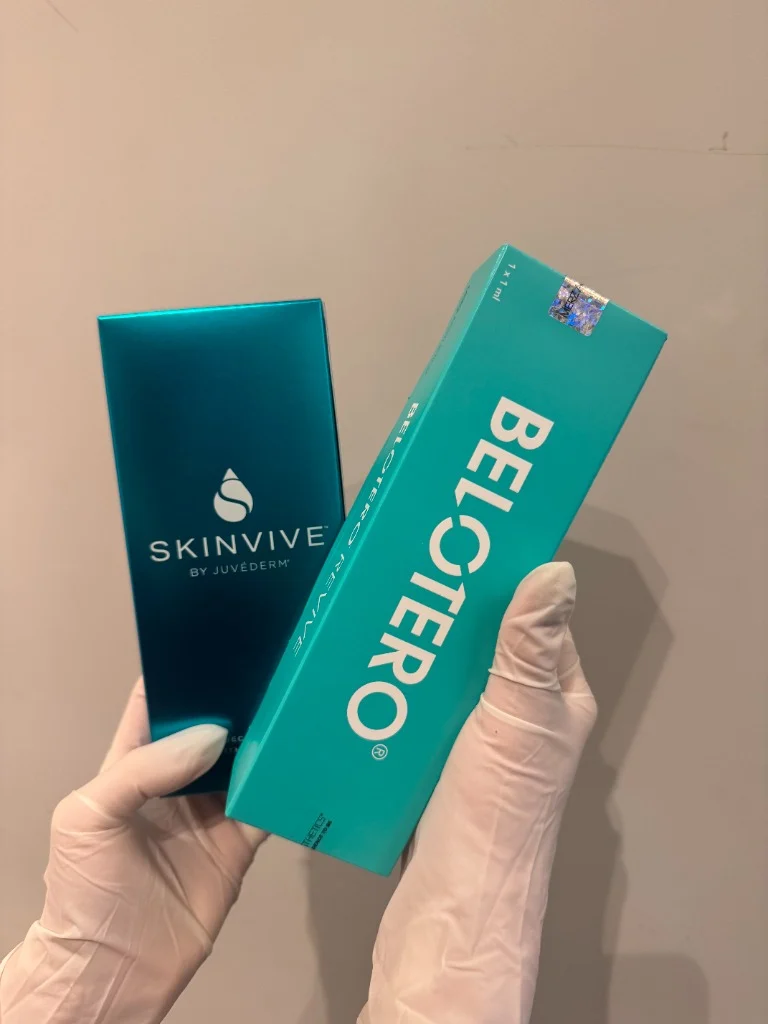
Similar Names, Different Chemistry: How SKINVIVE (VYC-12L) Differs From Belotero Revive (CPM-HA20G)
In Gangnam consultation rooms, one of the most frequent questions I hear from both Korean and international patients is straightforward: “Skinvive and Revive sound almost identical—are they basically the same product made by different companies?”
The short clinical answer is no. While both are built on cross-linked hyaluronic acid, their formulation philosophies diverge on four concrete parameters: HA concentration, gel matrix architecture, secondary humectants, and built-in local anesthetic.
SKINVIVE™ by JUVÉDERM® (VYC-12L) uses a lower HA concentration of 12 mg/mL cross-linked via Allergan’s VYCROSS® technology and includes 0.3% lidocaine inside the syringe, with no glycerol. Belotero® Revive (CPM-HA20G), developed by Merz Aesthetics, combines a higher 20 mg/mL HA concentration inside a Cohesive Polydensified Matrix (CPM®) with 17.5 mg/mL of glycerol—and contains no lidocaine. In peer-reviewed European studies (Hertz-Kleptow et al., 2019; Kerscher et al., 2021), adding glycerol alongside cross-linked HA was specifically intended to support stratum corneum hydration, elasticity, and early photodamaged skin quality.
Why Both Are Classified as Skin Boosters—Not Traditional HA Fillers—Despite Their Differences
If one gel has 12 mg/mL HA and the other has 20 mg/mL HA plus glycerol, why do modern Seoul skin clinics place both under the “skin booster” umbrella rather than calling them dermal fillers? The answer rests on three shared clinical boundaries.
First is the target anatomical plane: traditional contouring fillers are deposited into the deep dermis, subcutaneous fat pads, or supraperiosteal plane to restore structural volume or sharpen facial angles. Both SKINVIVE™ and Belotero® Revive, by contrast, are delivered as fine, evenly dispersed micro-deposits within the superficial-to-mid dermis.
Second is mechanical behavior: neither gel is engineered to push facial tissue outward with high lifting elasticity (G’). Instead, both integrate softly into dermal micro-spaces to bind water, calm surface micro-roughness, and improve light reflection. Third is clinical intent: patients receiving either treatment are not asking to reshape their cheeks or chin—they are pursuing skin quality (hydration, smoothness, bounce, and early fine-line softening). In contemporary aesthetic medicine, classification follows biological job rather than raw chemical family.
Head-to-Head Formulation & Clinical Comparison: SKINVIVE™ vs. Belotero® Revive
Putting VYC-12L and CPM-HA20G side by side clarifies why their similar names mask two genuinely distinct formulation strategies.
| Clinical Criterion | SKINVIVE™ (VYC-12L) | Belotero® Revive (CPM-HA20G) |
|---|---|---|
| Manufacturer & Cross-Linking Matrix | Allergan Aesthetics (AbbVie) — VYCROSS® technology blending low- and high-molecular-weight HA for smooth microdroplet distribution | Merz Aesthetics — CPM® (Cohesive Polydensified Matrix) multi-density gel engineered for seamless intradermal tissue integration |
| HA Concentration & Secondary Components | 12 mg/mL cross-linked HA + 0.3% lidocaine built into the syringe (no glycerol) | 20 mg/mL cross-linked HA + 17.5 mg/mL glycerol humectant (no lidocaine; topical anesthesia typically used) |
| Primary Clinical Goal & Regulatory Context | U.S. FDA PMA P110033 cleared for intradermal microdroplet injection to improve adult cheek skin smoothness and hydration without altering contour | CE-marked & Korea MFDS approved for early photodamaged facial skin revitalization—targeting hydration, elasticity, firmness, and superficial fine lines |
| Typical Clinical Study Protocol | Usually designed around a single intradermal microdroplet session with cheek smoothness improvements evaluated through 6 months in pivotal trials (individual duration varies) | Evaluated in European multicenter trials using a staged regimen (commonly 3 sessions spaced 4 weeks apart) to build cumulative hydration and viscoelasticity |
| Shared Safety & Technique Discipline | Still cross-linked HA: exact intradermal depth prevents beading or Tyndall effect; sterile technique, vascular awareness, and hyaluronidase readiness remain non-negotiable | Higher HA density + glycerol attracts water actively: uniform superficial-to-mid dermal placement, sterile protocol, vascular vigilance, and hyaluronidase readiness remain mandatory |
Dr. Yeonjin Kim’s Clinical Perspective: Why I Favor Tailored Combination Therapy (2 mL + 1 mL) for Moisture-Oil Balance
When patients ask me which one is “better,” my honest clinical answer often surprises them: in my Gangnam practice, I do not view SKINVIVE™ and Belotero® Revive strictly as an either/or choice. In fact, I frequently prefer tailored combination therapy—pairing SKINVIVE 2 mL with Belotero Revive 1 mL, or in other cases Belotero Revive 2 mL with SKINVIVE 1 mL—with the core goal of restoring skin moisture-oil balance.
Why combine them rather than choosing only one? Because the two formulations complement each other mechanically and biologically. SKINVIVE™ (12 mg/mL VYCROSS HA with 0.3% lidocaine) excels at creating an even, soft intradermal hydration reservoir that smooths cheek texture without heaviness, while Belotero® Revive (20 mg/mL CPM HA with 17.5 mg/mL glycerol) adds cohesive dermal density and glycerol’s active humectant support for compromised moisture barriers. Adjusting the ratio—2 mL SKINVIVE + 1 mL Revive when smooth hydration and lightness lead, or 2 mL Revive + 1 mL SKINVIVE when surface barrier dryness, early fine lines, and moisture-oil imbalance are more pronounced—allows me to calibrate the finish to each patient’s sebum and hydration profile.
Of course, this combination ratio represents my personal physician-tailored clinical approach rather than a standardized manufacturer label, and it is never a one-size-fits-all recipe. Some patients—such as international travelers seeking a streamlined single-agent cheek smoothness session—do best with SKINVIVE alone, while others need non-HA barrier recovery or energy-based lifting first. Deciding between single-agent care and a 2 mL + 1 mL combination always starts with examining skin thickness, sebum output, and facial anatomy in person.
Primary Regulatory & Clinical References
- [1]U.S. FDA PMA: U.S. FDA Premarket Approval (PMA P110033) — SKINVIVE™ by JUVÉDERM® (VYC-12L) Intradermal Cheek Smoothness Indication ↗
- [2]PubMed / Dermatologic Surgery (2023): Alexiades M, Palm MD, Kaufman-Janette J, et al. A Randomized, Multicenter, Evaluator-blind Study to Evaluate the Safety and Effectiveness of VYC-12L Treatment for Skin Quality Improvements. Dermatol Surg. 2023. ↗
- [3]PubMed / CCID (2019): Hertz-Kleptow D, Hanschmann A, Hofmann M, Reuther T, Kerscher M. Facial skin revitalization with CPM®-HA20G: an effective and safe early intervention treatment. Clin Cosmet Investig Dermatol. 2019;12:563-572. ↗
- [4]PubMed / PRS Global Open (2021): Kerscher M, Prager W, Fischer TC, et al. Facial Skin Revitalization with Cohesive Polydensified Matrix-HA20G: Results from a Randomized Multicenter Clinical Study. Plast Reconstr Surg Glob Open. 2021;9(12):e3973. ↗